

Twelve months ago, 21 women and gender-diverse changemakers gathered on Wulgurukaba Country in Townsville for a week that would ripple far beyond the shores of the Great Barrier Reef. The WELA Great Barrier Reef Leadership Intensive, run in partnership with the Great Barrier Reef Foundation, ignited new confidence, connection and collaboration in a region on the frontlines of the climate crisis.
Designed by and for women and gender-diverse people working across the Reef’s vast catchments, the Intensive built a shared sense of purpose and strengthened a network of leaders committed to creating a better future for the Reef, their communities and ecosystems.
Over the past year, stories from the 2024 cohort have shown the lasting impact of investing in women’s environmental leadership. From mobisiling Reef communities at the grassroots, to global policy platforms, these leaders have advocated for the Reef and climate justice at every level.
This leadership in action and progress comes at a critical time. In the past 12 months, the Great Barrier Reef faced heat stress, coral bleaching, and flood plumes—resulting in significant and potentially long-term damage. The latest coral bleaching event was the sixth mass bleaching event in nine years, driven by an underwater heatwave and intense rainfall—both fuelled by climate change. Scientists warn these threats will only worsen as the climate crisis deepens, highlighting the urgent need for diverse and collaborative leadership.
In response, women and gender-diverse leaders have stepped up, taking action for the Reef both locally and globally. From national airwaves to international platforms—such as the Third United Nations Ocean Conference (UNOC3) in Nice, France—they are raising their voices, shaping policy conversations, and leading with courage and collaboration.

Image credit: Magnetic Island Photos


Image credit (First): Lorima Dalituicsma
We were proud to see WELA alum and Divers for Climate Founder and CEO, Dr. Yolanda Waters, making waves on the international stage at the UN Ocean Conference — representing the dive community and frontline ocean and climate experiences in global discussions. Yolanda joined important conversations around the possibility of a “Blue COP” — a future UN Climate Summit that could finally put oceans and frontline communities at the heart of climate policy. With Australia in discussions to co-host COP31 in 2026 alongside Pacific Island nations, these dialogues are more urgent than ever. Yolanda brought her leadership to a meeting with Australia’s Minister for the Environment and Water, convened by Ocean Decade Australia, where she championed the inclusion of divers and marine tourism in national climate policy and planning.
Yolanda’s participation is a powerful example of bold, collaborative leadership that connects local stories to global change. As she shared submissions and voices from thousands of divers and marine tourism professionals, she ensured that what matters to people on the frontlines of climate and ocean disruption was part of the conversation. Her leadership in Nice showed community, care, and justice can ripple far beyond our own shores. Yolanda and the team at Divers for Climate are currently working to scale up their initiatives and ensure that the needs and concerns of those who depend on and are deeply connected to the sea are reflected in national and international climate discussions. We can’t wait to see how these conversations evolve as momentum builds toward COP31 — and how young women continue to shape the future of climate leadership, from our reefs and kelp forests to the world stage.
Yolanda says:
“Being in that big multilateral space was kind of daunting at first and it felt a bit disconnected from the work we are doing on the ground with Divers for Climate. But I was grateful to be invited into certain discussions and once I was able to share some of the work we are doing and the concerns of our community, I really felt like we were finally being heard. It’s a long way to go for a few meaningful conversations, but it meant a lot to be able to make those connections and understand more about the different pathways to change at scale. It has given us lots of ideas for when COP comes to our shores and dive sites, we’re excited!”
Since the intensive, Alex stepped into the role of Community Campaigner at the Cairns And Far North Environment Centre (CAFNEC), leading conservation and climate justice campaigns across Far North Queensland. Alex’s work centres the voices of communities on the frontlines—those impacted by climate disasters and extractive development—and builds grassroots power to influence policy decisions at both state and federal levels.
Alex says, “Among the many lessons WELA offered, a few have stayed with me every day: that leadership doesn’t require perfection, but presence; that working with emotion and grief is not a weakness, but a source of strength; and that advocacy must be collaborative, relational, and grounded in values”.
While other leaders in the cohort protect ecosystems through research or restoration, Alex’s contribution is focused on mobilising people and shifting systems—working political levers, empowering communities, and holding decision-makers to account.
“WELA helped me see my role clearly and gave me the tools and confidence to lead from where I stand: at the intersection of community, storytelling, and systems change.”
One year after attending the WELA Great Barrier Reef Leadership Intensive, life looks radically different for Alex in the best possible way,
“Being selected to join a cohort of bold, diverse, and deeply committed women was an honour and a turning point. Surrounded by leaders working across field research, mangrove restoration, Traditional Owner engagement, youth climate action, and policy reform, I found myself part of a living map of interconnected strategies—all essential to the future of the Reef. It was through WELA that I began collaborating with incredible women like Le’a Dawes, Tanya Murphy, and Yolanda Waters, who continue to inspire and challenge me”.


Tanya Murphy’s leadership has gone from strength to strength since attending WELA and GBRF’s Great Barrier Reef Leadership Intensive. She led a powerful, community-driven campaign to keep Reef protection on the political agenda during the Queensland state election, mobilising 71 passionate volunteers—many from the local dive and tourism community—who contributed over 550 hours. Together, they reached thousands through market stalls, door-knocking, petitions, and events, and hosted a successful Candidates Forum that sparked hundreds of meaningful conversations about the Reef’s future.
Tanya’s also making waves through her Word on the Reef podcast, which highlights key challenges and wins for the Reef told by diverse changemakers committed to the Great Barrier Reef. Tanya’s podcast is now a regular feature on Cairns FM89.1. Her storytelling platform continues to grow, enriched by connections built through WELA and grounded in inclusive, community-led advocacy. Tanya’s leadership on and off the airwaves is creating space for more meaningful conversations and community-driven storytelling that reflect a deeper, more inclusive vision for environmental advocacy.
Through grassroots efforts and collective courage, WELA women like Tanya are showing that leadership from the ground up can help secure a future where the Reef thrives.


In April, Karen and the CoralWatch team successfully delivered the CoralWatch Youth Ambassador Workshop during a four-day immersive school holiday program on Darumbal Country (Yeppoon). In collaboration with the Woppaburra Land and Sea Rangers, the workshop engaged nine families in hands-on reef conservation activities.
The program included snorkelling experiences at Woppaburra, community engagement sessions, and practical training in coral monitoring and marine stewardship—empowering young participants with the knowledge and skills to help protect the Great Barrier Reef.
Karen was featured in an interview on ABC Capricornia, which also aired on the weekend local news. You can listen to her interview here (starting at 1:14:00): ABC Capricornia Saturday Breakfast


Jodi is a passionate marine researcher and conservation biologist whose work has spanned across the globe, from the Great Barrier Reef to Mozambique. As the General Manager of Reef Check Australia, she leads impactful community-driven reef health and marine debris monitoring programs, empowering individuals to take action for the ocean.
The Leadership Intensive, designed to foster women’s environmental and climate leadership in the Great Barrier Reef region, allowed Jodi to strengthen her network and deepen her knowledge in climate adaptation and reef restoration. Reflecting on the experience, Jodi shared, “This Leadership Intensive was a great way to connect with new leaders in the marine space and learn new strategies. Collaboration is key to making any significant changes. It’s about strengthening those connections, it’s about making sure that we are genuine, that we lift each other up, and we support each other wherever we can.”
Following the program, Jodi addressed the gender imbalance in public discussions about marine conservation, pushing for greater visibility and recognition of women in leadership roles. Her efforts exemplify her belief that empathy, emotional intelligence, and authenticity are crucial to impactful leadership. “Women leaders are often more empathetic as leaders and emotional intelligence plays a pivotal role in leadership and impact.”
Recently Jodi’s contributions to sustainability and marine conservation were recognised when she was named Sunshine Coast Business Woman of the Year in Sustainability for 2024. Jodi continues to inspire by integrating her scientific knowledge with her leadership skills to foster meaningful, lasting change for marine ecosystems and the communities that rely on them.
Shirley Johnson, from Wulgurukaba Aboriginal Corporation, has deepened her work to protect and promote cultural heritage on Yunbenun (Magnetic Island), advocating for stronger recognition of Traditional Owners and building cross-cultural partnerships that centre Indigenous knowledge in marine conservation.
“The connections I made during the intensive continue to support my work. Having this community around me has made a real difference — personally and for our mob.”
Dr. Paige Strudwick, Postdoctoral Research Associate at UTS, has led new collaborations with community groups along the Reef’s southern catchments, using her research to better connect science and local storytelling.
“The confidence I gained from WELA has helped me speak up more, take the lead in meetings, and connect with allies I might have overlooked before.”
As a participant in OzFish’s Young Leaders Program, Katie was selected to attend the Great Barrier Reef Leadership Intensive.
Reflecting on the experience, Katie highlighted the importance of diverse leadership traits such as courage, empathy, adaptability, authenticity, inclusivity, and tenacity. She emphasised the need for new leadership approaches to address environmental challenges, stating, “The leadership that got us to where we are today, won’t be the leadership to get us out.”
Katie’s journey underscores the power of community action in making a difference in local waterways and the Reef. Her participation in the WELA Intensive has further empowered her to drive change and inspire others in the environmental sector. Read her full reflection here.
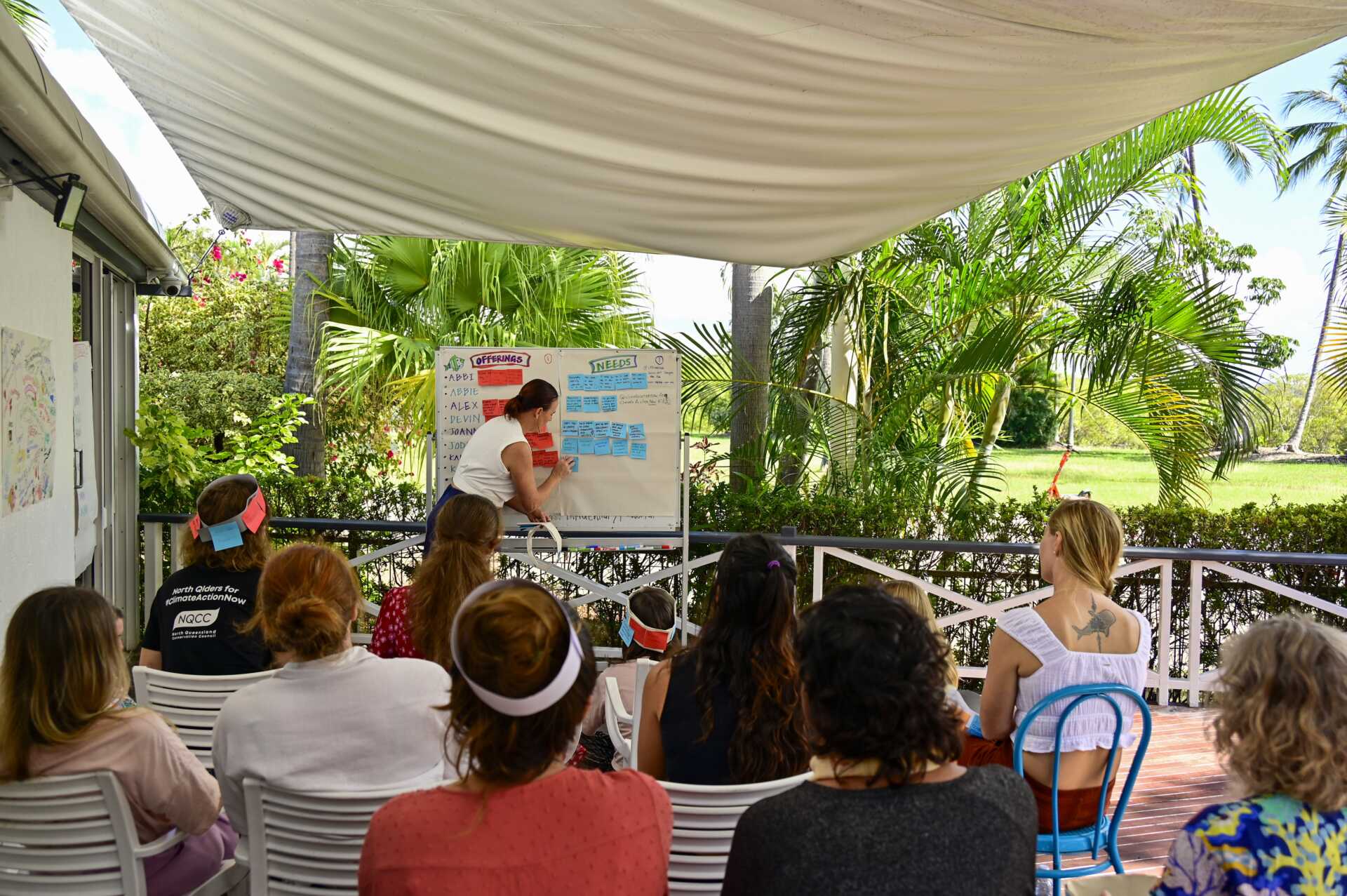
Image Credit: Magnetic Island Photos
Kaspa Blewett is charting a unique path in marine conservation, blending hands-on stewardship with creativity and education. Recently appointed as Coastal Stewardship Engagement Officer on Magnetic Island (Yunbenun), Kaspa also earned her coxswain qualification, allowing her to work with local marine organisations and strengthen on-water conservation efforts.
Her work spans the Coral Sea and iconic research hubs like Lizard and Orpheus Islands, where she supports scientific research, art, and community engagement. As co-editor and photographer for a marine species reference guide for Magnetic Island, Kaspa is dedicated to connecting people with science through art, fostering deeper connections to the ocean and its ecosystems.
A number of cohort members have initiated or joined joint projects in the months since the program. These include:
– A region-wide knowledge-sharing initiative between conservationists, tourism operators and Traditional Owners.
– A cross-sector climate adaptation workshop series led by participants in Cairns and Mackay.
– Peer mentoring groups that continue to meet monthly, offering accountability and support.
“It’s rare to be in a space where we can talk about leadership, burnout, strategy, and the emotional toll of this work — and still come away feeling hopeful and strong.”
Several alum have also reported internal shifts within their workplaces and networks. These include:
– Advocating for equity-based hiring and program design within large NGOs.
– Introducing wellbeing and feminist leadership frameworks into local council environmental teams.
– Influencing Reef-related policy consultation processes to better represent women and gender-diverse voices.
“After WELA, I felt equipped to challenge some long-standing practices in my organisation. We’ve since reviewed our community engagement processes to better include marginalised voices.”
One of the most powerful outcomes of the program has been the continued connection between participants. WhatsApp groups, regular Zoom catch-ups, and meet-ups at conferences have helped sustain the energy and momentum sparked in Townsville.
In June 2025, many of the alum reunited at the Reef Futures conference, where several presented together on a panel about feminist leadership for marine resilience — a direct result of the bonds and vision formed during the Intensive.

As climate pressures on the Great Barrier Reef continue to mount, so too does the need for bold, connected, and inclusive leadership. The stories from this cohort remind us that leadership doesn’t always look like a loud voice at the front of the room. It’s often found in quiet persistence, collaboration, and the ability to listen deeply and act with care.
We’re proud to walk alongside these remarkable leaders and look forward to seeing how they continue to shape a future where both people and the Reef can thrive.
With gratitude to all those who made this program possible — especially our partners at the Great Barrier Reef Foundation — and to every participant who has turned learning into leadership.
The WELA Great Barrier Reef Leadership Intensive was funded by the partnership between the Australian Government’s Reef Trust and the Great Barrier Reef Foundation.
Applications for WELA’s 2025 programs are open now. Learn more at the link below: